
A minimum deposit casino in Canada advertises a low entry figure, often as a round sum such as $5 or $10. That number is real, but it is narrow. It usually belongs to one payment method, it says nothing about the smallest amount you can withdraw, and it ignores fees that take a much larger bite out of $5 than out of $100. Before choosing a low deposit casino, read three figures in the cashier and the terms: the deposit minimum for your method, the withdrawal minimum for your payout method, and every fee in between.
This page explains where those figures come from and how to read them. It names no operators and does not quote casino minimums, because those change and differ by method and account.
Why a minimum deposit casino has more than one minimum
The headline minimum is a marketing number. The cashier is where the real ones live, and a cashier can show a separate minimum and maximum beside each method. A site that advertises a $5 minimum deposit casino offer may accept $5 by one route and ask for more on another.
Payment products bring their own floors as well, and they sit underneath whatever the casino sets.
Prepaid codes. Paysafecard sells Canadian codes worth 10, 30, 50, 100, 150 and 250 CAD (how paysafecard works). You cannot buy a 5 CAD code, so a $5 deposit means buying 10 CAD and leaving the rest on the PIN. Flexepin’s Canadian vouchers start at $20 face value (Flexepin FAQ). On these routes the smallest voucher sets your real minimum, whatever the casino lists.
Interac e-Transfer. Interac states that transaction limits are set by your financial institution (Interac). The casino sets its own minimum and maximum, and both sets of limits apply at once.
Cards. The casino sets the card minimum. Your card issuer decides how it classifies the payment, which matters more for cost than for the minimum itself (see below).
Crypto. Crypto cashiers list minimums per coin. Alberta’s regulated operators do not accept crypto at all, according to the AiGC. The crypto casinos guide covers networks and conversion costs.
The method with the lowest advertised minimum is not necessarily the one with the lowest cost, which is where most small-deposit plans go wrong.
What a $5 deposit really costs
Fixed fees are the problem. A charge that looks trivial on a large deposit becomes a big share of a small one. Take a hypothetical $1 fixed fee: on $100 it is 1%, on $20 it is 5%, on $5 it is 20%. Percentage fees scale with the amount; fixed fees do not.
Real Canadian examples show the shape of it. Flexepin’s FAQ lists a convenience fee added on top of the voucher value for vouchers sold in Canada: $1.95 on a $20 voucher, $4.95 on $100 and $15.95 on $500. On the smallest voucher that fee is close to a tenth of the face value. Paysafecard states that using the product and paying are “generally free of charge”, but it charges a fee for transactions with a currency conversion, and from the 19th month it deducts a monthly service fee of 2.50 CAD from any credit left on a PIN (paysafecard fees and limits). A forgotten 5 CAD remainder from a $5 deposit would be gone after two such months.
Bank routes are cheaper at the provider level but not always free. Interac says it does not charge e-Transfer fees directly to end customers and sends fee questions to your financial institution (Interac on fees). Whether your bank charges depends on your account.
Card deposits are the one to check before anything else. The Financial Consumer Agency of Canada explains that financial institutions often classify gaming transactions as cash-like, which can bring fees and interest from the transaction date (FCAC on credit cards). Alberta’s player FAQ says approved operators accept major credit cards and advises asking your bank about possible cash advance fees. On a small deposit, a flat cash-advance fee can outweigh the deposit itself.
Currency is the last layer. If the cashier works in US dollars or euros, your bank or provider converts every deposit and every withdrawal, each time with a margin. On small amounts the rounding alone can show.
Use the calculator to put your own numbers in. Leave a field empty when the fee is not published; the tool treats it as unknown, not as zero.
See the whole cost.
Enter the figures you have found in the casino terms, your provider's fee schedule and your card or bank agreement. Leave a field empty when nobody has published it: the result then says the total is incomplete instead of treating the gap as zero.
Your breakdown
- Amount
- –
- Casino charge
- –
- Provider or bank charge
- –
- Conversion cost
- –
- Illustrative total of known charges
- –
Each percentage is applied to the amount you entered, not stacked on another fee. Results are rounded to the cent. This is arithmetic on your inputs, not a quote from any casino or bank.
Matching the method to a small amount
Put the pieces above side by side and a pattern appears. For a genuinely small deposit, the method matters more than the casino’s headline.
An Interac e-Transfer from a bank account has no provider fee at Interac’s end, and the amount is whatever you type, within your bank’s limits and the casino’s minimum. For many readers that makes it the plainest route for a small sum, provided the casino supports e-Transfer for both deposits and withdrawals on your account. The Interac casinos guide explains how to confirm that before paying in.
A paysafecard code is fine when the amount you want to spend matches a code value. It fits less well with a $5 minimum deposit casino offer, because the smallest Canadian code is 10 CAD and the difference stays on the PIN. If you would use the rest at another merchant anyway, that is no loss; if not, the 19-month service fee eventually takes it.
A Flexepin voucher starts at $20 plus its convenience fee, so it does not suit a $5 plan at all. The voucher’s value, not the casino’s minimum, decides the deposit.
Credit cards are the route where a small deposit can cost the most relative to its size, because of how issuers may classify the transaction. Ask the issuer before the first payment, not after the statement arrives.
Crypto adds network and exchange costs on both legs, and the coin’s value moves in between. For an amount as small as $5, those layers can be larger than the deposit.
None of this tells you a $5 minimum deposit casino is a good or bad choice. It tells you which part of the cashier to read.
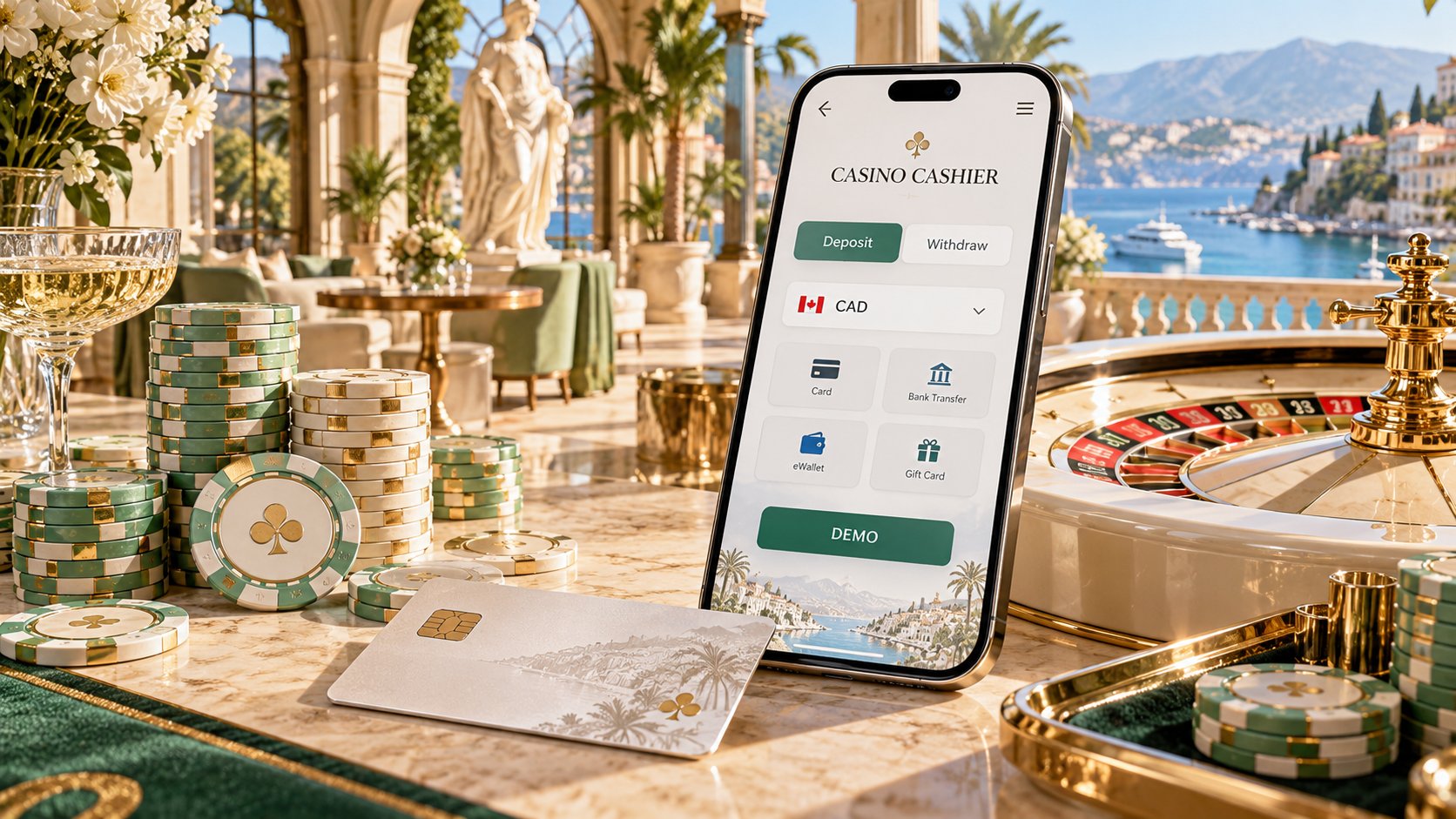
Your phone. Your payment route.
iPhone: Apple Pay
- Check device support
Apple Pay needs a supported card from a participating card issuer, added to Wallet on your iPhone.
- Check casino acceptance
Merchant acceptance also depends on the card network. Confirm with the casino that Apple Pay is listed in its cashier, and with your issuer that the card allows gambling payments.
- Plan the cashout
Apple Pay presents your card; it is not a separate balance you withdraw to. Expect the payout to go to another method, such as Interac or a bank transfer.
Android: Google Pay
- Check device support
Google Pay also presents a card you already hold. Check in the wallet app and with your card issuer that your card can be added.
- Check casino acceptance
Confirm with the casino that Google Pay is listed in its cashier, and with your issuer that the card allows gambling payments.
- Plan the cashout
Expect the payout to go to another method, such as Interac or a bank transfer, and ask the casino which one before the first deposit.
A device choice does not mean a casino offers that wallet. Read the mobile wallet notes
Low deposit, high withdrawal minimum
This is the trap that catches people with small balances. A low deposit casino can accept $5 in and still set a much higher minimum for withdrawals. If your balance ends up between the two, the money cannot leave until it grows past the withdrawal minimum, and growing it means playing more.
An illustration with hypothetical figures: deposit $5, finish the evening on $18, and find a $20 withdrawal minimum on your payout method. The $18 is yours on paper and stuck in practice. The only ways forward are to play on, which risks the whole balance, or to deposit again to cross the line. Neither is a choice you would make on purpose, so check the withdrawal minimum while it is still an abstract number.
Read the withdrawal side before the first deposit:
- the minimum withdrawal for the method you would use to cash out;
- whether that method is available to you at all, given how you deposited;
- any withdrawal fee, and whether it is fixed or a percentage;
- which identity documents the casino needs before the first payout; FINTRAC’s guidance says casinos covered by Canada’s anti-money-laundering law must verify identity for certain transactions.
Prepaid deposits make this sharper. Paysafecard and similar codes are built for paying in, so the payout goes to a different method with its own minimum. The paysafecard casinos guide explains that split, and the withdrawal times guide covers how long the stages take once a request is in.
Bonus minimum versus cashier minimum
Two different minimums often appear side by side, and they answer different questions. The cashier minimum is what the payment system will accept. The bonus minimum is the qualifying deposit written into a promotion’s terms. A deposit can clear the first and miss the second.
Bonus terms can also exclude certain payment methods, cap what you can withdraw from bonus winnings, or attach wagering conditions that make a small deposit hard to turn into a withdrawable balance. Read the bonus terms as a separate document. If a promotion would push you to deposit more than you had planned in order to qualify, the simplest answer is to skip the promotion.
Start from your budget, not from the minimum
A low minimum is useful for one thing: trying a cashier with a small amount to see how deposits and withdrawals behave before trusting it with more. It is not a reason to deposit more often. Five $5 deposits in an evening are a $25 evening, and the fees from the section above come five times.
The order that works is the reverse of the advertising. Decide what you can afford to lose this month, split it across the sessions you plan, and only then look for a cashier whose minimum fits inside a session. The planner below does that split. It runs only in your browser.
A worked example with made-up numbers: a reader sets $80 for the month and plans four sessions. That is $20 a session. A $5 minimum fits inside it, but the session budget is still $20, and once it is spent the session is over, whether the last deposit was $5 or $20. The minimum decides how finely you can slice the money. It never decides how much there is.
Set the limit. Keep it yours.
Planning example, not a casino limit
Enter an amount to see it split per session.
Nothing you type leaves this page or changes a casino account. To make a limit binding, set it in the operator's account settings, where deposit limits are usually applied immediately and increases may need a waiting period. Only choose an amount you can afford to lose.
Many casino accounts let you set deposit limits. Alberta’s player FAQ, for instance, describes deposit, loss and session-time limits in the account settings. The Responsible Gambling Council publishes safer gambling tips, and the responsible gambling page here lists support services by province.
Province rules in Canada still apply
A small deposit does not change who may play. The minimum age is 18 in Alberta and 19 in British Columbia, and this site’s operator coverage does not include Ontario. A low minimum deposit casino in Canada that is licensed only abroad may not be authorised where you live; the availability guide and the licence check guide show how to look that up.
Before a small first deposit
0 of 8 checked
Ticks are saved only in this browser.
A last detail: minimums are the casino’s terms, and terms change. A figure on a promotion page is not a promise about next month’s cashier, so look at the cashier itself each time you deposit.
Common questions
What is a minimum deposit casino?
It is a casino whose cashier accepts small first deposits. The headline figure normally belongs to one payment method; other methods at the same site can have higher minimums. Always read the minimum shown beside the method you plan to use.
Can I deposit $5 with paysafecard?
Only if the casino's paysafecard minimum is that low, and the smallest Canadian paysafecard code is 10 CAD. A $5 deposit from a 10 CAD code leaves 5 CAD on the PIN, and paysafecard deducts a monthly service fee of 2.50 CAD from residual credit from the 19th month.
Is a $5 minimum deposit casino cheaper to use?
Not automatically. Fixed fees weigh much more on small amounts: a $1 fixed charge is 20% of a $5 deposit and 1% of a $100 one. Flexepin's Canadian convenience fee, for example, starts at $1.95 on a $20 voucher.
Can I withdraw a small balance?
Only if it reaches the casino's withdrawal minimum for your payout method. Withdrawal minimums are set separately from deposit minimums and can be higher. Read them before the first deposit so a small win does not end up stuck below the threshold.
Does the welcome bonus have the same minimum as the cashier?
Often not. A bonus usually states its own qualifying deposit, which can be higher than the cashier minimum, and some bonuses exclude certain payment methods. Read the bonus terms on their own; the cashier minimum only tells you what the payment system accepts.
Are card deposits a good option for very small amounts?
Check with your card issuer first. The Financial Consumer Agency of Canada notes that many financial institutions treat gaming transactions as cash-like, which can bring fees and interest from the transaction date. A cash-advance fee on a $5 deposit can cost more than the deposit is worth to you.
Does Interac charge a fee on a small e-Transfer deposit?
Interac says it does not charge e-Transfer fees directly to end customers and directs questions to your financial institution. Your bank or credit union may have its own fee depending on your account, and it also sets your e-Transfer limits.
Is a low deposit casino safer for my budget?
A small minimum only lowers the entry point; it does not limit what you spend over a month. Decide your monthly amount first, use the casino's deposit limits, and stop when that amount is gone. The responsible gambling page lists support services.
Do I need ID for a small deposit?
Licensed casinos verify identity, and a first withdrawal is a common point for that check, whatever the deposit size. Have ID ready so a small payout is not held up by a document request.
Sources
- paysafecard (Paysafe Group)Checked October 19, 2026
- paysafecard (Paysafe Group)Checked October 19, 2026
- FlexepinChecked October 19, 2026
- Interac Corp.Checked October 19, 2026
- www.interac.caChecked October 19, 2026
- Financial Consumer Agency of CanadaChecked October 19, 2026
- AiGCChecked October 19, 2026
- Financial Consumer Agency of CanadaChecked October 19, 2026
- AiGCChecked October 19, 2026
- Government of British ColumbiaChecked October 19, 2026
- FINTRACChecked October 19, 2026
- responsiblegambling.orgChecked October 19, 2026